znr
Selasa, 29 Mei 2012
5 cool camouflage homes
From the fanciful to the frugal, camouflauge homes widely vary in design and utility.
Photo: Feliciano GuimarĂ£es
If you’ve ever wished you could just disappear, a camouflage home may be the answer. Noticeably unnoticeable, the sometimes-quirky, sometimes-glorious homes run the architectural gamut from sprawling modern estates to funky little mud huts built by hand. So, what’s the one thing they all have in common? Design that emphasizes disguise.
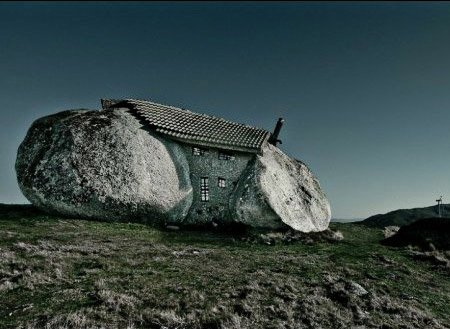
Consider the Casa do Penedo, or House of Stone. Fashioned from a space created by four monolithic stones, the house blends into the landscape in a way that is as fanciful as it is comical. The house was built in 1974 as a getaway for the Portuguese family that owns it in a location that was remote and private. But now its owner reports having to vacation elsewhere to escape the droves of curious onlookers who visit it each year.
When the homeowner is there, the boulder-abode provides more than its rough edges and hard surfaces might suggest. Inside, there’s a fireplace for chilly nights and mornings. The furniture, much of it made from wood and stone, is rustic and comfortable. Stairs and a landing, created from logs, are quiet underfoot and everywhere, when the sun sets, there is candlelight since there’s no electricity. Outdoors, a swimming pool, carved from the rock, provides a way to enjoy warmer weather.
Wood House, Hilversum, Netherlands
Looks can be deceiving: this wooden home's built mainly out of steel and plastic.
Photo: Thomas Mayer
This mini-dwelling is disguised as a pile of wood that's been stacked for the winter. In actuality, the building is a pre-fab structure made of steel and plastic. The log-like appearance was achieved by applying a wood veneer. When its windows are popped open, light pours in, making it perfect for a recording and practice studio for musician Hans Liberg
Casa do Penedo, Fafe Mountains, Portugal
A fairy tale home with ameneties to match--home lacks electricity and relies on candlelight.
Photo: Feliciano GuimarĂ£es
What looks like left-over boulders from the Stone Age is actually a house. Casa do Penedo or the 'House of Stone', was built until 1974 with four different boulders. The Portuguese getaway has no electricity so the homeowners use candlelight to see when indoors. That said, the house the boasts a cozy fireplace, a swimming pool carved into stone and logs for stairs.
Leaf Box, San Francisco, CA
The art studio blends into its urban garden setting and nods to adjacent Presidio Park.
Photo: Scott Green Landscape Architects
This modern cube, which stands behind a San Francisco row house, is actually an art studio. The verdant plant life that grows on its walls was introduced to make the boxy building blend into the property's adjacent parkland. Where the cube is now, there used to be a humble storage shed. Scott Green Landscape Architects redesigned the structure. It now serves as both a garden sculpture and a shelter.
Dune Home, 1941 1943 Beach Ave, Atlantic Beach, FL 32233
This bunker-like home boasts two stories and carries a price tag of $1 million.
Photo: William Morgan
Carved into the dunes of Atlantic Beach, Florida these two psychedelic apartments are pure 1970s. Native landscaping on the exterior ensures comfortable 70-degree temperatures indoors. Created by architect William Morgan, they were constructed using technology that was devised to create gunite swimming pools. The two-story suites include beach-level terraces, lower level living spaces and upper level bed- and bathrooms accessible via a common stairway. The home is currently on the market for $1 million.
Dragon Rock, Garrison, New York
A naturalistic terrace overlooks the quarry lake.
Photo: Trazzler.com
Industrial designer Russell Wright designed this retreat, called Dragon Rock, in the 1960s. Nestled into a rocky hillside among 75 acres of trees and woodland gardens, the house and studio overlook a quarry pond. The home's “camouflage features” include a vertical tree trunk supports in the dining area, jutting rock-face in the great room and bathroom, a living green roof and a naturalistic terrace overlooking the quarry lake.
Jumat, 25 Mei 2012
Another bear falls from tree in Colorado (PHOTOS)
The bears don't grow on trees in Colorado, but they sure are making a habit of falling from them. The Steamboat Pilot & Today reports that another black bear has been tranquilized and immortalized in photos as it fell from a tree to safety.
The Colorado Division of Parks and Wildlife tranquilized the bear after it climbed up a tree in Steamboat Springs.
It was just a month ago that another young black bear dominated the Internet after a student photographer captured a priceless photo of the bear falling from a tree after local firefighters tranquilized it. Sadly, it was just one week later that the same bear was killed after it wandered onto a Colorado highway and was struck by a passing motorist.
The worst traffic In America? It's not Los Angeles
Los Angeles might seem to be the nation's capital for gridlock, but according to Inrix, a provider of traffic data and information, the City Of Angels doesn't have the worst traffic in the United States.
Inrix says that the city of Honolulu wins that dubious honor, with drivers wasting 58 hours a year on average on congested roads.
The Inrix study shows that drivers in other major cities are still spending a fair number of hours stuck in traffic, too. While Los Angeles ranked a close second to Honolulu, those in San Francisco spent almost 48 additional hours in the car because of traffic.
The news wasn't all bad, though. Inrix says overall congestion was down 30 percent in 2011 from the year before, and notes that of the 100 cities it surveyed, 70 of them logged lower rates of congestion year over year.
These cities had the worst traffic in 2011, according to Inrix, which lists the average hours wasted per driver after each city:
10) Chicago – 32.8 hours
9) Boston - 35 hours
8) Austin – 30 hours
7) Seattle – 33 hours
6) Washington, D.C. – 45 hours
5) Bridgeport, CT – 42 hours
4) New York – 57 hours
3) San Francisco – 48 hours
2) Los Angeles – 56 hours
1) Honolulu – 58 hours
The study also finds that, nationally, the worst morning commute occurs on Tuesday, while the worst evening commute is on Friday.
Inrix also says some of the worst traffic corridors in the country include the 405 freeway in Los Angeles, from the 105 to Getty Center; a 16-mile stretch of the Long Island Expressway in New York; and three miles of the Penn Lincoln Parkway in Pittsburgh.
For more information and complete results of the survey, see the Inrix report card and methodology.
Selasa, 15 Mei 2012
Wango Tango 2012
Justin Bieber did a bit of a moon walk Saturday when the “Boyfriend” singer took the stage at the 15th annual Wango Tango concert for Los Angeles’ 102.7 KISS FM. His sagging jeans reached an all time low. The complete backside of his underwear were in full view when he made a brief cameo appearance to introduce performer Carley Rae Jepsen, a fellow Canadian artist he was instrumental in getting signed to Schoolboy/Interscope Records. See what other superstars played sets. – Billy Johnson Jr.
Russian Sukhoi plane missing on test flight in Indonesia
JAKARTA (Reuters) - A Russian Sukhoi passenger plane with 50 people on board, including businessmen and Russian envoys, went missing during a demonstration flight near a volcano on Indonesia's Java island on Wednesday, officials said.
Indonesia's search and rescue agency said radio contact with the plane was lost at about 0800 GMT after the jet descended to 6,000 feet around Mount Salak, a volcano 7,254 feet above sea level, south of the capital Jakarta.
The Superjet 100 plane - Russia's first all-new passenger jet since the fall of the Soviet Union - was carrying Indonesian businessmen, Russian embassy officials and journalists, and a search by helicopter and land had so far not found it, Indonesian and Russian officials said.
Transport ministry spokesman Bambang Ervan said the plane was flying at 10,000 feet and asked for permission to descend to 6,000 feet. "The last contact was when they asked for permission to descend from 10,000 feet to 6,000 feet," Ervan said.
"The plane was doing the first flight around midday and returned to the airport, but when it took off the second time, it lost contact around Bogor," Ervan said.
Those on board included eight crew and 42 guests according to the latest figures from the Russian embassy in Jakarta, Sunaryo, chairman of Sukhoi's Indonesian agent PT Trimarga Rekatama, told a news conference.
There were eight Russians on board, including pilots and technicians, Dmitry Solodov from the embassy said earlier.
"The search operation, by chopper and on the ground, has not found the plane until now," said Solodov.
The country's search and rescue agency is looking for the jet near one of many volcanoes that form the backbone of Indonesia's main island. Air traffic accidents are common in the sprawling Southeast Asian archipelago of 17,000 islands.
"Salak's a big mountain, I didn't hear anything," said Jocean Bowler, an American running an organic farm on the slopes of the mountain, visible from the capital on clear days and a popular tourist destination.
Olga Kayukova, a spokeswoman for Russia's United Aircraft Corporation, told Reuters the Sukhoi Superjet-100 was on a second flight as part of a demonstration program in Indonesia.
"The first flight was carried out in a normal mode ... The pre-flight preparations were carried out in full and the plane was completely ready to fly," she said.
"According to information from Indonesia, the contact with the plane was broken after 20 minutes from the take-off, at 1435 local time," Kayukova said.
Sukhoi, which has orders for 170 planes worldwide, plans to produce up to 1,000 superjets, primarily for foreign markets. It aimed to sell 42 planes to Indonesia, which is seeing a fast expanding aviation market to tap travel by a growing middle class in the world's fourth most populous nation.
The jet was developed with Western design advice and technology from Boeing and Italy's Finmeccanica, as well as avionics and engine equipment from French aerospace firms Thales and Safran.
Built in a converted corner of a Sukhoi fighter factory in Siberia, it was first unveiled in 2007 as part of a drive to curb Russia's dependence on oil and gas and restore pride in its aviation industry, but ran into a series of development delays.
The Superjet 100, with a capacity of 68-103 passengers, is already in service with Russia's Aeroflot and Armenian carrier Armavia and is half way through a 15,500-km (9,630-mile), six-nation Asian tour to try to drum up more international customers.
The aircraft is being marketed internationally in partnership with Finmeccanica subsidiary Alenia Aeronautica.
Pilot Bravado May Be to Blame for Superjet Disaster
foolhardy maneuver by the pilot may have led to the crash of the Sukhoi Superjet 100 in Indonesia last week. Hopes were high that the new passenger jet could revive Russia's aviation industry and the pilot wanted to do all he could to ensure success.
ions about this topic.
Print
E-Mail
Feedback
05/14/2012
Champagne Before the Crash Pilot Bravado May Be to Blame for Superjet Disaster
By Matthias Schepp and Gerald Traufetter
Photo Gallery: Search Continues for Sukhoi Crash Victims
Photos
DPA
A foolhardy maneuver by the pilot may have led to the crash of the Sukhoi Superjet 100 in Indonesia last week. Hopes were high that the new passenger jet could revive Russia's aviation industry and the pilot wanted to do all he could to ensure success.
Info
The Superjet had just entered Indonesian airspace on its demonstration flight when a half-naked passenger wielding a shiny, silver trident made his way into the cockpit. Sergey Dolya, a 39-year-old Russian travel journalist and aviation blogger, had bared his chest, tied on a long white beard and donned a crown made of silver paper.
Dolya had slipped into the role of the god Neptune north of Jakarta, the Indonesian capital. "I imitated an equator-crossing ceremony 10,000 meters above sea level," he says. "Usually only seamen do that."
Dolya wanted to celebrate the fact that a Sukhoi SSJ 100 ("Superjet") had penetrated the Southern Hemisphere for the first time. All the hopes of Russia's aviation industry rest on this passenger jet, designed by a company with an 80-year history of manufacturing military aircraft.
The plane was on a demonstration tour aimed at breaking into the dynamic Asian market. President Nursultan Nazarbayev had already inspected the Superjet when it made an intermediate stop in Kazakhstan. Now the Russians were hoping to make an impression on potential buyers in Indonesia.
The mood on board was fantastic, and Dolya reports there was champagne. In the cockpit, the copilot snapped a photo of the faux Neptune with his cell phone. Indonesian flight attendants wearing high heels and short skirts posed for pictures.
A Level-Headed Pilot
A day later, the Russian crew of eight and all of the plane's 37 passengers were dead. It would appear that Alexander Yablontzev, the captain on the flight, had allowed himself to become infected by the general exuberance during the Wednesday afternoon demonstration flight.
Strictly speaking, hardly any other pilot was better qualified to man the controls on the test flight in Jakarta than the 57-year-old veteran. Friends describe him as a level-headed pilot. He had logged over 10,000 flying hours on more than 80 different types of aircraft. And when the Superjet made its maiden flight in May 2008, Yablontzev was the test pilot sitting in its cockpit.
Russian photographer Marina Lystseva likewise has nothing bad to say about Yablontzev. The young Moscow resident and friend of Dolya was very lucky: The only reason she wasn't on the afternoon flight was because she had already taken enough pictures on the morning flight. She has known Captain Yablontzev for a long time and says he loved the airplane and "wanted the jet to succeed with every fiber of his body."
There is much to suggest that this is precisely what led him and his passengers to their demise. Indeed, the pressure to make sure the Superjet mission succeeded was massive. Only in February, when he was still Russia's prime minister, President Vladimir Putin signed a €43 billion ($55 billion) program whose stated goal was to help Moscow's aviation industry capture 10 percent of the global market for passenger aircraft by 2025. At present, its market share is less than 1 percent.
To date, most of Sukhoi's Superjet sales have been to Aeroflot, Russia's state-run airline, at a cut-rate price of just €15 million apiece. But the Kremlin envisions the SSJ 100 as a future global competitor to aircraft that are twice as expensive, especially Canada's Bombardier CRJ and Brazil's Embraer 190.
The Most Spectacular Air Show Possible
Many experts doubt the Superjet will be able to establish a foothold in the highly competitive global market, and the embarrassing disaster in Indonesia makes its prospects even grimmer. For now, the important thing will be to swiftly determine the cause of the crash. Did the aircraft malfunction, or is the crew to blame? "Pilot error would naturally be the best outcome for Sukhoi," says William Voss, president of the Virginia-based Flight Safety Foundation.
Even if technical problems are not ruled out, the evidence points in that direction. The flight path alone, which has been reconstructed using radar data, leads one to suspect that the Superjet's final flight was mainly about one thing: offering potential buyers of the competitively priced regional jet the most spectacular air show possible.
Immediately after taking off on Wednesday afternoon, Captain Yablontzev turned south, flew over the city of Bogor and made an initial circle around the volcano on whose steep sides the flight would soon meet its tragic end. The crew then requested permission to descend to 1,800 meters (5,900 feet), though its reasons for doing so remain a mystery. "In this mountainous region," says Voss, the aviation expert, "there is no reason for a sensible pilot to descend to such an altitude."
Nevertheless, Yablontzev steered the airplane directly toward Mount Salak, the dormant volcano the Jakarta Post has dubbed "an airplane graveyard." Indeed, several aircraft have crashed into the mountain, including an Indonesian Air Force plane in a June 2008 accident that claimed 18 lives.
It was precisely here that Yablontzev wanted to show off the aircraft's abilities. To make matters worse, massive clouds were gathering around the mountain at the time. Locals consider the area the rainiest and stormiest in all of Indonesia.
Reckless Bravado
A number of factors make approaching the volcano an incalculable risk, including steep mountain ridges, the steaming-hot rainforest and the chaotic air-circulation patterns. What's more, the airplane was most likely shooting above the rugged landscape at a speed of 130 meters per second (290 miles per hour).
It is almost impossible to safely maneuver passenger planes like the Superjet under such circumstances -- particularly because, unlike with military jets, the engines of these planes only react to thrust commands with a slight delay. For this reason, passenger airlines are supposed to maintain a 1,000-meter safety buffer from mountains -- a rule that Captain Yablontzev apparently violated. "The crash casts a spotlight on the mind-set of Russian aviation," says Heinrich Grossbongardt, an aviation expert based in the northern German city-state of Hamburg. With any Western airline, he adds, such behavior would be viewed as reckless bravado.
Images from the crash site show that the airplane was banking to the right when it slammed into the mountainside. This could indicate that Yablontzev was making a final attempt to pull the airplane up and over the mountain range. "The pilot had absolutely no experience with the area's unique topographical traits," notes Jan Richter, a Hamburg-based flight-safety expert.
What's more, one photo taken by the blogger Dolya right before the flight suggests that the automatic terrain warning system was turned off. The photo shows part of the instrument panel in the plane's cockpit, and the button corresponding to the warning system clearly shows a "fault" message and that it is deactivated.
'Like Being Born Again'
This wouldn't be the first time that hubris had led to fatal consequences in an airplane demonstration show. Probably the most famous example was the 1988 crash of an Airbus A320 during an air show in the Alsatian town of Habsheim. While flying over the runway, the jet suddenly dropped and slammed into a nearby forest. A year earlier, an Airbus A300 crashed during a practice flight near the Egyptian city of Luxor. And, in 1994, the test flight of an Airbus A330 in Toulouse, France, ended in catastrophe. As a consequence, Airbus' main competitor has a hard and fast rule: At aviation trade fairs, Boeing pilots are forbidden from making any kind of risky maneuver no matter how much they might wow potential buyers.
For Sukhoi, the crash could bring an already simmering crisis to a boil. Although more than 200 of the planes have been ordered, a lack of qualified personnel and sufficient expertise in the serial-production process has meant that only eight of the Superjets are currently in use: seven by Russia's Aeroflot and one by the Armenian airline Armavia.
What's more, even these customers are unhappy. In March, Konstantin Mokhna, Aeroflot's deputy chief engineer, humiliated Sukhoi when he complained about "technical problems" and delays in replacement-part deliveries. To corroborate his complaints, Mokhna cited some embarrassing figures: Instead of being able to keep his Superjets in service for the industry average of eight to nine hours a day, he could only use them for 3.9 hours per day. "For potential buyers, these revelations are even more unsettling than the crash in Indonesia," says New York-based aviation expert Richard Aboulafia.
Meanwhile, Dolya, the Neptune-impersonating blogger, and Lystseva, the photographer, have been walking through Jakarta as if in a trance. They still can't grasp what has happened. "By a hair, we would also be lying dead on this horrifying mountainside," Lystseva says. "It's like being born again."
Russian aviation, on the other hand, will have to continue waiting for its renaissance.

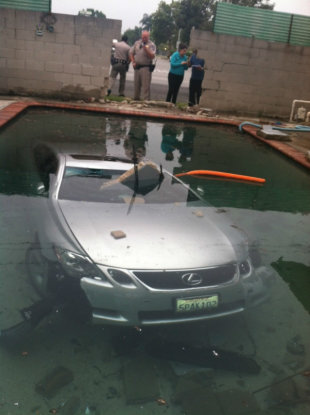
Lexus found submerged in family’s swimming pool; drunk-driving suspected
A 40-year-old California man is accused of driving his Lexus through a cinder block wall and into a family's backyard swimming pool. The man, Modesto Cabral, was arrested on suspicion of driving under the influence on Sunday after the 5:25 a.m. one-vehicle crash.
Pieces of the wall were seen stuck in the car's windshield. An orange swimming noodle was floating near the driver's side door.
The La Puente, Calif., family described the bizarre scene to reporters. "We woke up to an awful noise and looked outside, and a car was in the pool," Janelle Diaz, the family's 16-year-old daughter, told the San Gabriel Valley Tribune. "We had always joked around about it—that someone was going to end up in the pool—because they've hit our wall before."
The driver apparently drove his silver 2006 Lexus GS430 straight through a "T" intersection—and through the concrete wall. He climbed out of the car through the right front window after the car became submerged.
Shawn Johnson lost 25 pounds after ‘hurtful’ fat talk
Gold medalist gymnast Shawn Johnson gained, then lost, 25 pounds during her three-year break from international competition, she told reporters on Monday.
The 20-year-old, who won three silver medals and one gold in Beijing and is attempting a comeback for London, discussed the weight gain, and her subsequent body image problems at the USOC media summit on Monday. She said her fluctuating weight led to "hurtful" comments in the tabloids.
[Video: Shawn Johnson finds Olympic inspiration through family ]
"That whole process kind of broke me down and taught me something," she said, according to USA Today. "People put too much emphasis on looks."
Even when she was at the top of the gymnastics world, Johnson battled weight issues. "I was at the Olympic Games winning medals and I still doubted my image," she said. "I doubted what I looked like. That's sad. Girls should be taught different than that. I think everyone should be taught different than that."
Johnson put on the weight after the 2008 Olympics and her 2009 victory on ABC's "Dancing With the Stars." She tore her ACL during a freak skiing accident in early 2010 and added some heft to her athletic 4-foot-9 frame. Johnson said she'd perform Internet searches for her name and was horrified at the results.
[Photos: Athletes to watch at the London Games ]
She's not a certainty to make the U.S. team but is excited for the opportunity to compete for a spot at the upcoming Olympic trials.
"I'm getting stronger on a daily basis," she told Fox Sports last week. "I'm excited for June. This time around, I've taken a whole new approach and mentality."
Rabu, 09 Mei 2012
Cops to Be Tried in Alleged Fatal Beating of Homeless Man Caught on Video
Two Fullerton, Calif., police officers will be tried in the death of a mentally ill homeless man whose apparent beating by police was captured on video, a judge ruled today.
Officer Manuel Ramos, 38, and Cpl. Jay Cicinelli, 40, are charged in the death of Kelly Thomas, 37 -- Ramos with second-degree murder and involuntary manslaughter, and Cicinelli with involuntary manslaughter and assault or battery by a public officer, according to The Associated Press. Both have pleaded not guilty.
Attorneys for the officers have questioned whether medical treatment, not the actual beating, could have resulted in Thomas' death.
"The grainy-but-gripping video of a homeless man being beaten to death was the key evidence in the prosecution's successful effort to convince the court to force a police officer to stand trial for murder in the second degree," said Royal Oakes, an ABC News legal analyst, according to ABC News Radio.
"The video of the beating conjured up memories of the Rodney King police beating of two decades ago," Oakes said. "The videotaped evidence will no doubt be the centerpiece of the D.A.'s case in the upcoming murder trial, where one officer could be facing 15 years-to-life behind bars."
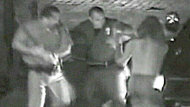
The July 5, 2011, surveillance video, taken from a publicly mounted camera, coupled with an audio recording device worn by an officer, stunned a packed courtroom of Thomas' supporters when it was shown for the first time Monday.
"I can't breathe man," and, "sorry," Thomas could be heard telling officers as he allegedly endured punches to his left ribs and blows to his face from an officer's knee.
Thomas, who is reportedly schizophrenic, repeatedly cried out for his father.
He was also Tasered three times with the stun gun applied directly to his skin for five-second periods. He was hit a fourth time with two darts connected to the gun by wires, according to the Orange County District Attorney's office. The entire time he could be heard screaming in agony.
The apparent beating lasted nine minutes and 40 seconds and ended with Thomas' limp body in handcuffs.
Thomas was transported to St. Jude Medical Center in Fullerton, Calif., for intubation to help him breathe. He never regained consciousness.
Five days later, Thomas died. The coroner's office ruled the death a homicide.
"You have 1,500 pounds of trained cop on my one little son, but they have to bring this out like they were just so overpowered by this brute to make themselves look innocent and that they're the victims," Ron Thomas, the victim's father, said outside of court Monday.
The officers had responded to the Fullerton Transportation Center after receiving a call that a homeless man was seen looking into car windows and pulling on door handles.
Six officers arrived at the scene for back-up, but the district attorney determined that there was only enough evidence to charge Ramos and Cicinelli in Thomas' death.
The video began with Ramos approaching Thomas and asking him to sit with his legs and hands in front of him. Thomas had trouble complying with the order and appeared to have cognitive difficulties, according to the D.A.'s office.
Fed up, Ramos made fists and asked Thomas if he saw them. Thomas replied that he did.
"They're getting ready to f--- you up," Ramos told him.
When a shirtless Thomas, who had earlier forgotten his name and said he didn't speak English, stood up, Ramos and his partner were shown swinging at him with their batons.
Thomas took off and was tackled, setting off the nearly 10-minute beating that allegedly led to his death.
Ramos is a 10-year veteran of the Fullerton Police, while Cicinelli has been an officer in Fullerton for 12 years.
The video ended with paramedics carrying Thomas' body to an ambulance, revealing a large blood stain on the spot where the altercation took place.
"We ran out of options so I got the end of my Taser and I probably ... I just start smashing his face to hell," Cicinelli said at the end of the July 5 video, according to the transcript provided by prosecutors to the Associated Press. "He was on something, 'cause the three of us couldn't even control him."
Thomas had no illicit drugs or alcohol in him at the time of the incident, according to the toxicology report.
If convicted, Cicinelli could face a maximum sentence of four years in prison and Ramos could be sentenced to life in prison.
Selasa, 01 Mei 2012
Bronx Zoo SUV plunge: Father who lost family says, ‘I want to die’
The SUV that plunged more than 50 feet from the Bronx River Parkway on Sunday, killing seven people from three generations of a Bronx family, was headed to a family reunion, stunned relatives said.
"I lost my family," said Juan Gonzalez, whose 45-year-old wife and 10-year-old daughter were killed in the crash, according to the New York Post. "What can I say? I don't want to be here. I want to die."
Gonzalez's wife, Maria, a Fordham University staffer, was driving her daughter, 85-year-old father, 81-year-old mother, 39-year-old sister and two nieces (ages 3 and 7) to a party at her sister's Bronx home when she lost control of the vehicle, police said.
The vehicle flew off an elevated portion of the parkway near the Bronx Zoo at about 12:30 p.m. local time, authorities said. It's not clear what caused the crash.
According to the Associated Press, the SUV was headed south when "it bounced off the median, crossed all southbound lanes over to the guardrail and fell."
Langganan:
Postingan (Atom)