znr
Selasa, 22 Januari 2013
Michelle Obama rolls eyes at John Boehner, sets Internet aflame
Monday’s post-inaugural luncheon was a case study in body language--and nearly all of the physical evidence centered on House Speaker John Boehner. One interaction in particular already became an Internet meme: Michelle Obama rolling her eyes after listening to a comment from the Ohio Republican congressman.
Tumblr blogger “Mattyrab” was the first to capture the eye roll in action, sharing video of the exchange in a display described as a “historical moment in shade throwing.” The video has already been shared thousands of times across social media sites with viewers speculating on what sparked the First Lady’s facial expression.
We don’t have audio of their exchange so, for now, it’s impossible to know exactly what Boehner had said. In fact, it’s entirely possible that Michelle Obama's eye roll was simply a reaction to an innocuous joke from Boehner.
That moment was only one of several interactions involving the House speaker. For example, after Boehner’s brief and gracious remarks during the luncheon, he shook hands with President Obama and Vice President Joe Biden. Anyone watching the two exchanges closely would notice a distinct difference: While Boehner and Obama look friendly enough in the actual handshake, at no point do they appear to make eye contact; in contrast, Biden and Boehner appear to share a warmer greeting, smiling at each other and pulling in close.
Of course, any analysis is inevitably colored by one’s own estimation of these three men. But it certainly appears to correlate with the understanding that Biden has far more amicable relations with Congress than Obama.
Interestingly, House Majority Leader Eric Cantor even appeared to have a warmer exchange with Obama after his remarks than the president had with Boehner, as the two men looked each other in the eyes and traded what appeared to be firm, but friendly, greetings. If that indeed is the case, it’s noteworthy since Cantor is viewed as being even more ideologically opposed then the House speaker to Obama’s political agenda.
What do you think? Are political audiences overreacting to Michelle Obama’s facial expression? Or was it a candid moment captured on film showing that even during the most benign of political events, personality conflicts and personal feelings rise to the surface?
Senin, 21 Januari 2013
"Sir, sir Hungry ..."
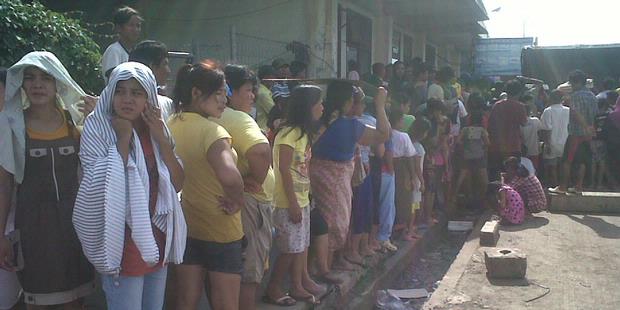
Since the floods began soaking on Thursday (01/17/2013), a new on Monday (01/21/2013), the water began to recede and allow flood victims in Kampung Muara Baru, which is adjacent to the Port of Muara Baru untouched help. On Monday (01/21/2013) afternoon, Kompas.com Brimob joined the entourage escort aid boats for the evacuation process. With two trucks and a pickup truck, Brimob group should take pains to get to the Port of Muara Baru, safe spot that is free from standing water, directly adjacent to the village of Muara Baru. Along the way, of Highway Pluit, Penjaringan District, to the Port of Muara Baru, hundreds of people trying to intercept a group of Brimob. In fact, the group is not too much to bring food because its main purpose is to review the flood situation and provide assistance raft. All members of the Mobile Brigade who join the group seemed awkward to face the demand of citizens. On the one hand want to help, but on the other hand are aware of the potential chaos that occurs when not all residents receive assistance. "Pak Pak hungry, hungry, sir," said the child victims of flooding in Muara Baru. Moreover, dozens of people trying to climb Brimob truck from behind. The reason, the residents thought Brimob group brings a lot of help in the form of food and medicine. However, the facts versus the opposite. The people who already ride in the truck group, and come up to the Port of Muara Baru, spilling her laments to members of the Mobile Brigade. Still, the limited stock of food brought to force the distribution of food distributed by super selective. Children and parents are priorities. Arriving at the Port of Muara Baru, hundreds of local residents immediately rushed towards the group Brimob. The people are still hoping to get groceries and medicines from coming Brimob group. Some members of the Mobile Brigade appear to provide some sandwiches wrapped chocolates to the children at the site. As of 15:00 pm, the residents go up in the truck was still at the Police Mobile Brigade Muara Baru area. They can not help, and returned to the house had to wait Brimob group is back. Given enough distance away, plus the height of the flood waters until 15:00 pm still reach about 80 centimeters.
Selasa, 03 Juli 2012
Abu Jibril, an inured, overlooked hardl-iner
“Beware of terrorists among us” reads a welcome banner upon entering the Witana Harja housing complex in Pamulang, South Tangerang, Banten.
It was installed by law enforcers more than six months ago following the arrest of Muhammad Jibril, the son of firebrand cleric Muhammad Iqbal Abdurrahman, widely known as Abu Jibril.
Muhammad was arrested for allegedly helping finance attacks on the JW Marriott and Ritz-Carlton hotels in July last year.
Since his arrest, and because of his background, it is hard for law enforcers or the complex’s residents to overlook his father when any terrorist incidents occur.
The US State Department said in 2003 that Abu Jibril was Jamaah Islamiyah’s (JI) primary recruiter and second-in-command after firebrand cleric Abubakar Ba’asyir.
The recent raids have again dragged Jibril into the spotlight as it was his follower, Fauzi, now a police fugitive, who allegedly harbored Dulmatin, the notorious JI field leader killed by police less than one kilometer from Jibril’s house on Tuesday.
Jibril confirmed Tuesday that Fauzi was his follower, but insisted he did not know Dulmatin. He has been living in the complex since November 2005, thanks to Ba’asyir henchman Sutisna, who, according to neighborhood cleric Abdurrahman Assegaf, set him up with accommodation.
Jibril, born in 1957, was a student of the Al-Mukmin boarding school in Ngruki, Central Java, founded by Ba’asyir and Abdullah Sungkar.
He now runs the arrahmah.com, a radical jihad movement news portal, and leads an exclusive prayer group of middle- and upper-income Pamulang residents.
The group was formed in 2006 when Jibril took over the Al-Munawwarah mosque from local residents. Ba’asyir regularly preaches at Jibril’s prayer meetings, advocating a jihadist movement.
“Before [Jibril] came here, the people had a very strong bond. We used to hold social and religious activities together,” said Rangga Baihaqi, 25, who lives in the same block as Jibril. “But now there’s a polarization between followers of Jibril’s congregation and those who aren’t. In some of his sermons I heard Jibril call non-followers infidels.”
He said participants of Al-Munawarah’s congregations were mostly outsiders, with local residents accounting for no more than 10 percent.
Jibril’s radical and extreme preachings were also confirmed by, another neighbor, Wawan, 56.
“After the arrest of his son, though, Jibril seems to have toned down his rhetoric.”
Jibril has a long record of participating in radicalism.
In early 1980s, Jibril spent three years in prison for his radicalism. He fled to Malaysia in 1985 following then president Soeharto’s crackdown on Islamic militants. According to police, he was recruited in Malaysia to fight in Afghanistan, eventually becoming a trainer there.
Following the Soviet withdrawal from Afghanistan, Jibril spent most of the 1990s in Malaysia helping Ba’asyir and Sungkar found JI. He was a treasurer along with Hambali, a key JI financier currently held in the US.
Jibril returned to Indonesia after Soeharto’s downfall in 1998. He played a role in supporting sectarian conflicts in Poso, Central Sulawesi until he was arrested by the Malaysian government, which held him from 2001 and 2004 under the country’s Internal Security Act for promoting radicalism.
But it was a small explosion in front of Jibril’s house in another part of Pamulang in mid-2005 that recalled much of Jibril’s past. .
The police claimed the device was similar to those used in sectarian conflicts in Poso between 1998 and 2000. They raided his house but laid no charges.
It was later revealed the police were hesitant to file the charges after pressure from politicians from the Prosperous Justice Party (PKS) and the National Mandate Party (PAN). PAN lawmaker Patrialis Akbar, now the justice and human rights minister, was among the lawmakers who stormed National Police headquarters demanding they drop all charges against Jibril. (rdf
Rabu, 27 Juni 2012
Weird laws to know before you travel

A ban on wearing high heels isn't enforced in Carmel, Calif. But not so Athens, Greece (Stockbyte)
You better bite your tongue when you visit Middleboro, Mass. Last week, residents voted in a town meeting to impose a $20 fine on any publicly uttered swear words.
While this may catch some travelers to the community by surprise, it’s not the only place the uttering of curse words is illegal. Here are some of the wackiest local laws that visitors should be aware of before venturing out.
1. Be careful what you wear
Laws governing clothing are common and should always be checked before traveling abroad. Qatar forbids indecent or revealing clothes, defined as “not covering shoulders and knees, tight or transparent clothes.” The Vatican City requires shoulder coverings and skirts or shorts to the knee in order to enter museums and churches. And, Castellammare di Stabia, south of Naples, has outlawed mini-skirts, low-cut jeans and too much cleavage, with violators risking a 300-euro fine.
Thailand has a law demanding that you wear underwear at all times – also a good idea in general.
In Italy, where foreign beach-goers can offend the local sensibility, laws often require cover-ups over swimsuits. In Lerici, on the Italian Riviera, you’re not allowed to walk the streets in just a swimsuit. That’s also true on the island of Capri, which has gone further to protect the serenity of the vacation spot by banning noisy shoes, such as clogs or wooden-soled sandals.
2. The shoes on your feet
Carmel, Ca., where Clint Eastwood was mayor, has a famous historic ban on woman wearing high heels. Though the law isn’t enforced, tourists can purchase a commemorative permit allowing them to wear the shoes.
But, you won’t get away with that in the historic sites around Greece. After many of the country’s landmarks, like the Acropolis, were damaged in recent years by visitors, the government banned people from wearing high heels at the ancient locations.
Urban legend also has it that the city of Blythe, Calif., bans people from wearing cowboy boots unless they own at least two cows. However, even the city manager of Blythe has never heard of that rule being enforced, so you’re probably safe in those boots.
3. Pull up your pants
While fashions change, one thing hasn’t. People wearing their pants sagged below the top of their boxers has had public officials up in arms for years. Five metro cities around Atlanta have banned saggy pants, skirts and shorts – specifically those more than three inches below the wearer’s hips. In Forest Park, Ga., violators can even face a $1,000 fine.
Montgomery County in Alabama levies a $100 fine against juveniles and $150 fine against adults with the slogan: “Raise your pants, raise your image.”
Delcambre, La., was the first town to make it a crime to “show your underwear in public.” There you can face six months in jail for a violation.
Senin, 18 Juni 2012
1923 Kanto Earthquake
With the massive quake and tsunami that struck Japan last week, the specter of another devastating event has returned: The 1923 Kanto earthquake, which shook the region around Tokyo, was the country's last "big one." The 7.9-magnitude quake reduced much of Tokyo to rubble, and as refugees tried to leave, firestorms swept through the city. More than 100,000 people died during the Kanto quake and its aftermath. These archival images, drawn from the U.S. Geological Survey, AP, and Brown University's Dana and Vera Reynolds Collection, show the horrifying wreckage. They're a reminder that Japan has faced brutally difficult rebuilding efforts before, and succeeded in building back better. [ See also, from the January 1924 edition of the Atlantic Magazine: Earthquake Days. ] (Alexis Madrigal and Alan Taylor) [24 photos]
Langganan:
Postingan (Atom)